Archive for February, 2010

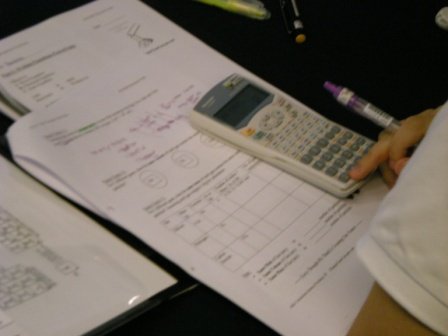
Do you find Mole Calculations difficult?

Do you find Mole Calculations difficult?

Mole Calculations, or commonly known as “The MOLE” or “Mole Concepts” is regarded by many of the GCE ‘O’ Level Chemistry students (as well as IGCSE and IB / IP Chemistry students) to be one of the most challenging and difficult topic.

Let’s not mention that many students are not able to score in this topic!

In fact, a large number of chemistry students simply “hate” Mole Calculations, because they:

  • Don’t know which formulae to use
  • Don’t even know how to start when they read the question
  • Can’t relate how mathematical manipulations are connected to chemistry theories
  • Can’t handle the fact the Mole Calculations are everywhere & anywhere in Chemistry Exams – they appear in questions that are linked to various other chemistry topics

As such, many students have in fact given up on Mole Calculations! But question is: Can they afford to give them up? Let me know your views on it? Do you think students can afford ignore Mole Calculations?

Even worst, we have received emails from chemistry teachers and chemistry tutors (tuition centre teachers) on the challenges in teaching their students. Many students seemed to “understand” the examples shared by their chemistry teachers during lecture but once the question is rephrased a little bit, students will be stunned and do not know how to carry on. Are you one of them? I would love to hear from you.

Recently, we have seen more students asking us to discuss more about Mole Calculations in this chemistry blogsite. One of my chemistry student, who is committed to do well in the October’s GCE ‘O’ Levels Chemistry Exams, had sent me a series of questions related to Mole Calculations. And one of them is a challenging application question that i have addressed last year (2009). Let’s check out the question:

Question:
12dm3 of polluted air is passed through limewater so that all the carbon dioxide is precipitated as calcium carbonate. The mass of calcium carbonate formed is 0.05g. What is the percentage by volume, of carbon dioxide in the air sample?

Now, take out your calculator, pen & paper – and try it out! Leave your answer (and even better, leave down your working) in the Comment section below.

I will be providing the solution soon. But before that, i would strongly suggest that you attempt the question first to see if you have the correct answer. =)

Suggested Solution:
Updated on 2nd March 2010:

For full screen video – click HERE

PS: If you are based in Singapore, there is a chance now that you can master Mole Calculations quickly & effectively. Click HERE for more information.

Mole Calculations has been voted as #1 Killer Topic for ‘O’ Level Chemistry

Click on the PLAY button (2 mins audio) to find out why!

Audio clip: Adobe Flash Player (version 9 or above) is required to play this audio clip. Download the latest version here. You also need to have JavaScript enabled in your browser.

molecalculationsworkshopsticker

>> Click HERE for Early Bird Registration to enjoy discounts & bonuses

Mole Calculations 2010

>> Click HERE for Early Bird Registration to enjoy discounts & bonuses

If you have only 2 mins to spare on my website today, go watch this motivational video below. Forget about the rest~


Click HERE for direct URL if you can’t view the above video

Whether you are a:

Students that didn’t do so well in GCE ‘O’ Levels Exam (or other exams) last year and landed in a course or school that you don’t have a choice apparently

  • Students that are facing the GCE ‘O’ Levels Exam this year 2010 (or other exams) but are struggling with the sheer amount of workload i.e, tests, worksheets, assignments, remedials, mock exams, whatever…
  • Educators (Principals, Teachers, Tutors, Trainers, Coaches) that work closely with kids, teenagers, young adults
  • Parents that consistently wonder why you cannot connect with your growing-up child, and crying over why your child has change beyond recognition, and did so many things against your wish…

Please do not give up!

Recall what he said: “If I fail, I will try again and again and again. It’s not the end. It all matters on how you going to finish. Are you going to finish strong? You will find the strength to get back.”

On a separate note;

In previous post, i have discussed about the role and elements that a good teacher (educator) (more…)

“Hi Sean, just want to say a BEEG thank you being an inspiring teacher. Your passion for Chemistry & dedication in teaching are a great motivation & inspiration to your students. You do not choose only the ‘A’ grade students but inspire them to be. Because of your help, Tim (Timothy) improved his Chemistry and was able to spend more time brushing up other subjects. Thanks!”
Mrs Ho, Parent of Timothy Ho, Gan Eng Seng School, C5 (Sec 3) to A2 (O Levels 2009)

  • With all the hype and anxiety about the release of 2009 GCE ‘O’ Level results finally coming to a stop;
  • With many of our 2009 students (of course including their anxious caring parents) settled enjoying the process of uncovering their new environment & making new friends in JC / IB institutions / Polytechnics;
  • With the many wonderful wishes and special praises from a group of appreciative parents;
  • With everyone being calm and mentally sound;

I think it is time for us to share our good news about our 2009 batch of Chemistry (Pure Chemistry & Combine Science) & Math (A / E) students.

Winners Education Group has helped another year of students to unleash their potential and produced excellent results with:

• 100% improvements!

• 98% of them have also scored ‘A’s & ‘B’s!

• 97% making improvement of 3 grades or more in Chemistry & A/E-Math!

Updates: Glad to know that (more…)

Last week, we have discussed on the Common Properties of a Group (in general).

Periodic Table - Authored by Sean

Today, let’s take a closer look at the properties of elements from 3 very important groups that examiners like to test you:

Properties of Impt Groups in Periodic Table:

Group I (Alkali Metals)

  • Soft & Silvery Metals
  • Low Densities & Low MPs
  • Has 1 valence electron
  • Forms ions with 1+ charge by giving away 1 valence electron
  • Reacts vigorously with cold water to form metal hydroxide alkaline solution & hydrogen gas
  • Reacts vigorously with chlorine gas to form ionic metal chlorides

Group VII (Halogens) (more…)

TEACHER = EDUCATOR ???

Since the inception of this F-R-E-E Chemistry website few days ago, i have received numerous emails and blog comments by educators from different regions – about the roles of  “Teachers” and “Educators”.

Many in Singapore associates Teachers to only NIE-Trained Teachers which applies to Primary, Secondary & Junior College Teachers. Personally, i thought more credit should be given to Kindergarden & Child-Care Teachers and Assistants, Tutors, Coaches, Instructors, Trainers, Polytechnics & Universities’ Lecturers, even parents & siblings. As such, Educators seemed to be a more correct term to used.

I did a quick check with my decade-old dictionary to find the terms  stated:

Teacher - person who gives systematic information to (person) or about (subject or skill); enable (person) to do something by instruction

Educatorperson who trains or instructs  mentally and morally, besides giving information

These days, children (especially this group of teenagers under “Y” Generation) are getting more matured earlier and have a mindset of their own. Giving of information to students and instructing them is no more effective. And thus the role of Educators / Teachers have to emcompass other elements in order to made their teachings more effective, such as:

  • Passion of the subject
  • Knowledge of subject (besides the textbook theories)
  • Motivation / Inspiration
  • Fun & Humorous
  • Classroom management

What do you think?

If you are an educator: Teacher, (more…)

In the previous blogpost, we have discussed about the General Features of the Periodic Table.

Besides that, students taking GCE ‘O’ Levels / IGCSE / IB / IP examinations would also need to master the Common Properties of a Group.

Common Properties of a Group

Elements in the same group have similar properties:

  • Same number of valence electrons
  • Usually form ions with the same charge
  • Form compounds with similar formulae
  • Similar physical properties
  • Similar chemical properties

In addition to the above, the following are observed as we go down a particular group:

  • Proton number increases
  • Number of electron shellls increases
  • Relative atomic mass increases

Now, go ahead and try out some exam-based question and leave your suggested answers below.

Quick Check 1:

Given that Strontium is (more…)

Search SimpleChemConcepts

Countdown to O Level Chemistry Exams 2010

  • 'O' Level Pure Chemistry P2 / Combine Sci P3:
    in 56 days, 19911 seconds
  • 'O' Level Pure Chemistry / Combine Sci MCQ Paper:
    in 70 days, 23511 seconds

Upcoming Event!

Full!

25 Ways To Improve Your Chemistry (Free)

FREE Copy of Intro Section “Up Your Chemistry Grades Now!”

Up Your Chemistry Grades Now! Book

Click HERE to get your copy

Search by Topics

Recommended Resources

Click here for A Level H2 Chemistry Tips

Get your  O Level Math Tips!

Vote Your Biggest Challenge in Chemistry

What is your BIGGEST challenge in Chemistry?

View Results

Loading ... Loading ...

Recent Comments

June Intensive Revision BootCamp 2010