
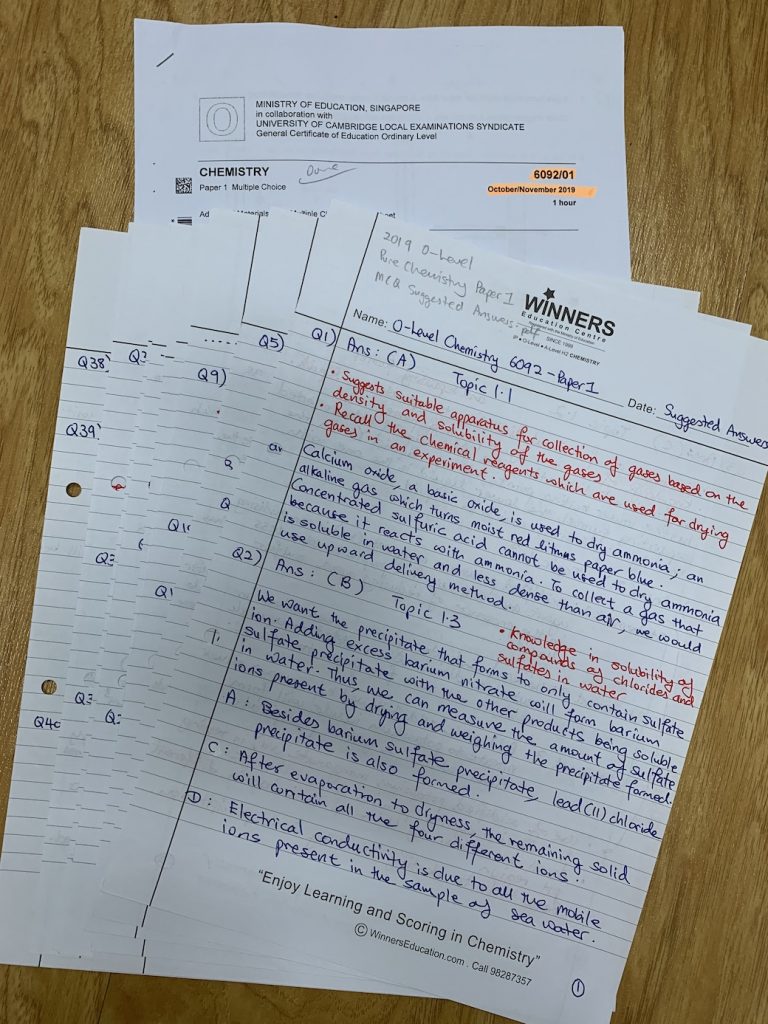
Check out the suggested answers for the recent 2019 O Level Pure Chemistry (subject code: 6092) Paper 1 MCQ by Singapore’s highly recommended O Level Chemistry and IP Chemistry tutor Mr Sean Chua who has been conducting O Level Chemistry and IP Chemistry Tuition Classes since 1999.
Answer Key to 2019 O Level Pure Chemistry Paper 1 MCQ:
| 1. | A (Topic: Experimental Techniques) |
| 2. | B (Topic: Qualitative Analysis QA) |
| 3. | C (Topic: Purification & Separation Techniques) |
| 4. | D (Topic: Qualitative Analysis QA) |
| 5. | D (Topic: Atomic Structure) |
| 6. | D (Topic: Chemical Bonding & Structural Properties) |
| 7. | C (Topic: Chemical Bonding & Structural Properties) |
| 8. | B (Topic: Macromolecules) |
| 9. | A (Topic: Chemical Bonding & Structural Properties) |
| 10. | C (Topic: Mole Concept & Chemical Calculations) |
| 11. | D (Topic: Mole Concept & Chemical Calculations) |
| 12. | C (Topic: Mole Concept & Chemical Calculations) |
| 13. | B (Topic: Electrolysis) |
| 14. | C (Topic: Electrolysis) |
| 15. | A (Topic: Energy Changes) |
| 16. | D (Topic: Energy Changes) |
| 17. | D (Topic: Speed of Reaction) |
| 18. | B (Topic: Speed of Reaction) |
| 19. | B (Topic: Redox Reaction) |
| 20. | A (Topic: Acids, Bases & Preparation of Salts) |
| 21. | C (Topic: Periodic Table & Group Trends) |
| 22. | A (Topic: Acids, Bases & Preparation of Salts) |
| 23. | C (Topic: Air & The Atmosphere) |
| 24. | C (Topic: Periodic Table & Group Trends) |
| 25. | A (Topic: Periodic Table & Group Trends) |
| 26. | B (Topic: Periodic Table & Group Trends) |
| 27. | B (Topic: Periodic Table & Group Trends) |
| 28. | A (Topic: Metals & Reactivity Series) |
| 29. | A (Topic: Electrolysis) |
| 30. | A (Topic: Metals & Reactivity Series) |
| 31. | D (Topic: Air & The Atmosphere) |
| 32. | A (Topic: Organic Chemistry) |
| 33. | C (Topic: Organic Chemistry) |
| 34. | A (Topic: Organic Chemistry) |
| 35. | B (Topic: Organic Chemistry) |
| 36. | B (Topic: Macromolecules) |
| 37. | B (Topic: Macromolecules) |
| 38. | C (Topic: Organic Chemistry) |
| 39. | D (Topic: Organic Chemistry) |
| 40. | A (Topic: Macromolecules) |
Summary of Topics Tested in Paper 1 Multiple Choice Questions:
- Experimental Techniques (x 1 question)
- Purification & Separation Techniques (x 1 question)
- Atomic Structure (x 1 question)
- Chemical Bonding & Structural Properties (x 3 questions)
- Acids, Bases & Preparation of Salts (x 2 questions)
- Qualitative Analysis QA (x 2 questions)
- Mole Concept & Chemical Calculations (x 3 questions)
- Periodic Table & Group Trends (x 5 questions)
- Metals & Reactivity Series (x 2 questions)
- Speed of Reaction (x 2 questions)
- Energy Changes (x 2 questions)
- Redox Reaction (x 1 question)
- Electrolysis (x 2 questions)
- Air & The Atmosphere (x 2 questions)
- Organic Chemistry (x 6 questions)
- Macromolecules (x 4 questions)
Analysis of O Level Pure Chemistry Paper 1 MCQ:
For 2019 O Level Pure Chemistry Paper 1 MCQ, Cambridge International Examiners are testing O Level Pure Chemistry students heavily on Periodic Table & Groups Trends, Organic Chemistry and Macromolecules. A total of 15 out of 40 questions were being tested based on those topics.
Topics on Kinetic Particle Theory and Ammonia were not tested at all. For the past 10-15 years, we usually have more questions on Acids, Bases & Preparation of Salts but for this year, we have only 2 questions.
In general, this paper is considered quite easy for those students who have strong foundation of their Chemistry Concepts and associated keywords. There weren’t any extremely difficult or tricky questions this year.
Lastly, there were 3 repeat questions based on the O Level Pure Chemistry Ten Year Series (2009-2018). Question 10 came out in 2014, Question 17 came out in 2016 and Question 38 came out in 2011.
Hope you find the suggested answers and the analysis useful towards your learning. Feel free to share it with your friends.
For Sec 3 & 4 Pure Chemistry and IP Chemistry students who are aiming to Pass Chemistry with Distinction, join us in our weekly Chemistry tuition classes (available in Bras Basah & Bishan) to stay consistent in 2020.
Personally taught by Mr Sean Chua. Only 4 classes every year. WhatsApp or Call us at 88290998 now!


Get your copy of 10 Year Series O Level Pure Chemistry book by SAP publisher for the full step solutions and explanations. Suitable for IP Chemistry students too!
Being invited book author by SAP publisher (authorised by Ministry of Education) Mr Sean Chua is not allowed to show much of the suggested solutions openly.

Check out Mr Sean Chua collection of Chemistry videos to help you to learn Chemistry better, faster and easier.