Many students are confused when it comes to the difference between the following terms commonly used in Mole Concept & Chemical Calculations, namely:
- Relative Atomic Mass
- Relative Molecular Mass
- Relative Formula Mass
- Molar Mass
In order to differentiate them (as well as see how they are connected to each other), we have to know their definitions first.
Let’s take a look at them one at a time…..
A) Relative Atomic Mass, Ar
The relative atomic mass of an atom is the average mass of one atom of that element compared to 1/12 of the mass of one carbon-12 atom.
Basically, it is not practical for scientists to use actual masses of atoms in scientific calculations since atoms have very small masses.
As such, scientists compare masses of different atoms with reference to the carbon-12 atom (which is an isotope of carbon).
To be more precise, the masses of all elements (in terms of atom) listed in The Periodic Table are always compared to 1/12 of the mass of one atom of carbon-12.
The symbol for relative atomic mass is Ar.
Relative atomic mass is a ratio and therefore has no unit.
If you refer to the Periodic Table, you will notice that the relative atomic masses of some elements are not whole numbers. These elements exist as a mixture of isotopes (which have different mass numbers).
The relative atomic masses that you see in the Periodic Table are calculated based on the relative percentage abundance of the isotopes. So, relative atomic mass is basically an average value after considering all the different isotopes of the element.
For GCE O-Level Pure Chemistry students (syllabus code 6092) in Singapore, the Periodic Table is not as precise as the one used by the GCE A-Level H2 Chemistry students (syllabus code 9729).
The following Periodic Table is used by GCE O-Level Chemistry students.

Notice that chlorine (atomic number 17) has a relative atomic mass, Ar of 35.5 which is not a whole number. In fact, most elements in the Periodic Table exist as isotopes and thus their relative atomic mass is not a whole number.
If you look at the Periodic Table used by more advanced Chemistry syllabus, such as GCE A-Level H2 Chemistry, most of the elements are not whole numbers. They are presented with 1 decimal place.

Let’s take a look at a classic example on how relative atomic mass is being calculated.
Example:
Chlorine exists as chlorine-35 (% abundance of 75%) and chlorine-37 (% abundance of 25%).
Hence, the relative atomic mass of chlorine = (75/100 x 35) +(25/100 x 37) = 35.5 (as shown in the Periodic Table)
Recap on the definition of Isotopes:
- Atoms of the same element
- Same number of protons and electrons
- Different number of neutrons
A) Relative Molecular Mass, Mr
The relative molecular mass of a molecule is the average mass of one molecule of that element or compound compared to 1/12 of the mass of one carbon-12 atom.
Many elements and compounds exist as covalent molecules.
The mass of a molecule (element or compound) is measured in terms of its relative molecular mass.
The symbol for relative molecular mass is Mr.
Relative molecular mass is also a ratio and therefore has no unit.
To calculate the relative molecular mass of a molecule, you need to add together all the relative atomic masses of all the atoms in its chemical formula.
Due to isotopic effects, actual molecular masses could be different when the atoms of each element present are isotopes.
Let me give you an example.
Carbon is known to exist in two isotopes: carbon-12 and carbon 13.
Oxygen is known to exist in three isotopes: oxygen-16, oxygen-17 and oxygen-18.
As such, we can have carbon dioxide, CO2 molecules with different molecular masses.
Note that for mole calculations, we tend to just use the relative atomic masses (average values) of the elements (as seen in the Periodic Table) and calculate the relative molecular masses (average values).
C) Relative Formula Mass, Mr
The relative formula mass of an ionic compound is the average mass of one unit of that ionic compound compared to 1/12 of the mass of one carbon-12 atom.
Ionic compounds such as sodium chloride and magnesium oxide do no exist as molecules.
As such, it is confusing to use the term relative molecular mass for ionic compounds.
Instead, we use the term relative formula mass.
Relative formula mass is given the same symbol of Mr and have no unit.
It is calculated in the same way as relative molecular mass for molecules, by looking at the chemical formula and adding up the relative atomic masses of atoms.
D) Molar Mass
Molar mass refers to the mass of one mole of a substance (which could be an element or a compound).
- The molar mass of an element (in terms of atom) is equal to its relative atomic mass (Ar) in grams.
- The molar mass of a molecular substance is equal to its relative molecular mass (Mr) in grams.
- The molar mass of an ionic compound is equal to its relative formula mass (Mr) in grams.
Example:
- The relative atomic mass of magnesium is 24. This means that one mole of magnesium atoms has a mass of 24 g. The molar mass of magnesium will thus be 24 g/mol.
- The relative molecular mass of carbon dioxide is 44. This means that one mole of carbon dioxide molecules has a mass of 44 g. The molar mass of carbon dioxide will thus be 44 g/mol.
In terms of Mole Concepts and Chemical Calculations, do note that there is really “no difference” between Molar Mass and Relative Atomic Mass (Ar) or Relative Molecular/Formula Mass (Mr). When it comes to calculation, you will end up with the same numerical answer.
And for this reason, i have seen educators (teachers and professional tutors) use the two terms interchangeably and causally.
Let me give you an example….
Chemists count particles by using a unit known as the Mole (SI unit is “mol”), which are used to determine chemical formulae of substances when they perform calculations.
One mole of any substance contains 6 x 10²³ particles. This is known as Avogadro’s constant or Avogadro’s number.
You will probably come across two similar looking formulae involving Mole and Mass when you are googling and searching online.
A) Mole of Element (mol) = Mass of Element (g) / Relative Atomic Mass of Element
Example: Say we have 24 g of magnesism
Answer: Mole of Mg = (24 g) / (24) = 1 mol
B) Mole of Element (mol) = Mass of Element (g) / Molar Mass of Element (g/mol)
Example: Say we have 24 g of magnesism
Answer: Mole of Mg = (24 g) / (24 g/mol) = 1 mol
As you can see, based on SI unit, Formula B is the more precise one because the units will cancel off nicely to give you “mol”.
However, you can also see that both formulae will give you the same answers of “1 mol”.
It also sometimes depends on the syllabus content given by their country’s Ministry of Education. School teachers tend to follow very closely. As a professional Chemistry specialist tutor in Singapore, i also follow it closely, so that i don’t have to argue with students who are attending my GCE O-Level and IP Pure Chemistry Weekly Tuition classes, whenever they say that the formula they saw in their school is slightly different.
Let me show you what i mean.
“Chemistry Matters” Textbook by Marshall Cavendish Education publisher is one of the two approved Pure Chemistry textbooks by Ministry of Education Singapore (MOE) which all Sec 3 and 4 Chemistry students have to get as a reference guide.
The formula to calculate the number of moles of substances is slightly different in 1st Edition (before year 2013) and in 2nd/3rd Edition (2013 onwards).
Formula A is printed in the 1st Edition (for use before Year 2013).

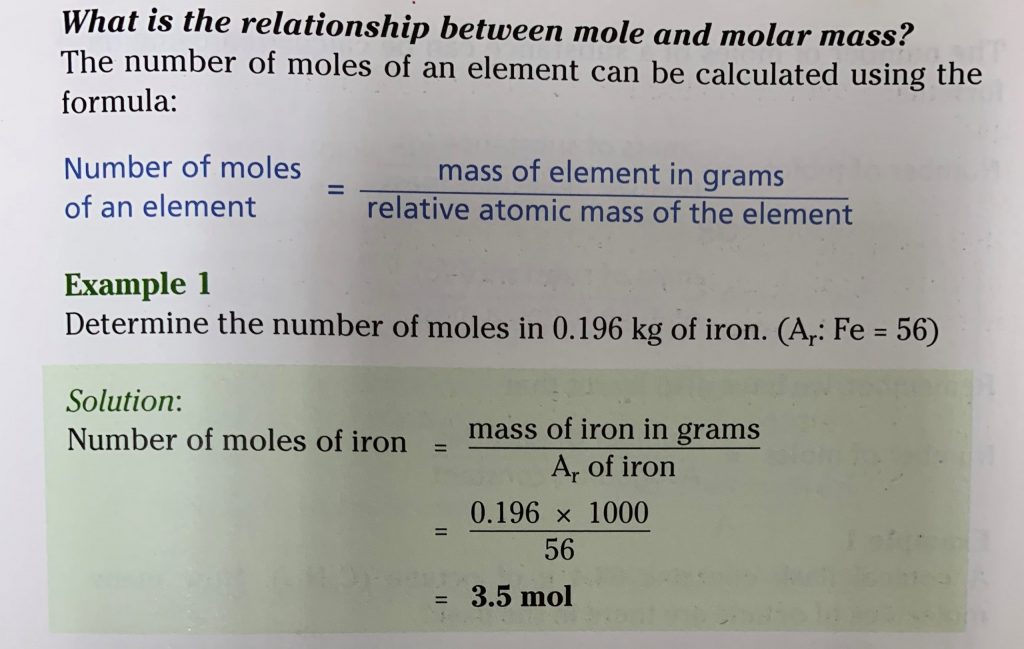
Formula B is printed in the 2nd Edition (for use from 2013-2017). The newest 3rd edition (2014 onwards) also follow this version.


So for all my customised Chemistry notes, YouTube videos and chemistry blogs before 2013, i have been using Formula A. I started to use Formula B from 2013 onwards.
You can see that i was using Formula A (use of relative molecular mass, Mr instead of Molar Mass) in one of my Chemistry YouTube Videos produced in April 2009 and has about 15,000 views. Wow, time really flies, this video is already 11 years old!
Hope the above is clear and you know the differences as well as the connection between the four common terms used in Mole Concept and Chemical Calculations.
Enjoy learning Chemistry with understanding! Get it right the 1st time!
If you have any questions, leave me a comment below. Feel free to share this blog post with your friends.
Subscribe to my blog to receive 2 updates per month sent to your email!
PS: Under related articles below, there are several blog post discussions and questions related to Mole Concept and Chemical Calculations. You can also do a keyword search using the search box at the top right hand corner.